
Home Inspection Checklist items look identical on paper no matter where you buy, but the building behind them rarely is and that gap is what trips up most New York buyers. A pre-war co-op on the Upper West Side, a Park Slope brownstone with a shared party wall, and a Long Island City condo tower each hide their problems in different places. Generic checklists written for suburban ranch houses miss almost all of them. What follows is the checklist we actually use in the field, built around how buildings in this city are constructed, regulated, and eventually repaired.
The stakes are higher here than almost anywhere else in the country. NYC housing stock spans four centuries of construction methods, and a huge share of it predates modern building codes entirely. You’re not just checking for leaks and cracked outlets you’re checking whether a building complies with rules set by the Department of Buildings (DOB), whether prior owners pulled permits for that finished basement, and whether the mechanical systems were built for 1920s heating loads or 2026 electric vehicle chargers. Skipping any of this doesn’t just cost you a repair bill later it can cost you the deal, the mortgage, or the resale value entirely.
Foundation and Basement: Where NYC Buildings Show Their Age First
Every inspection starts below grade, because that’s where the city’s geology and its infrastructure fight each other hardest. We check the cellar, basement, or crawlspace first not last because water and movement problems down here predict everything that will eventually show up upstairs.

In brownstones and pre-war buildings, foundations are often unreinforced rubble stone or rough-cut granite block set in lime mortar that has been slowly breaking down for a century. We run a hand along these walls looking for bulging, lateral displacement, or stepped cracking the kind caused by hydrostatic pressure pushing in from a high water table or from a street that no longer drains the way it did when the building went up.
Moisture is the real enemy here, and it rarely announces itself directly. Moisture intrusion usually shows up first as efflorescence that chalky white residue left behind when water evaporates through porous masonry. We trace the whole perimeter for damp drywall, peeling paint, or soft baseboards, and we bring an electronic moisture meter to catch what’s hiding behind a finished basement wall. In low-lying stretches of Brooklyn, Queens, and Staten Island, we also cross-reference the property against flood maps, because combined sewer overflow during a heavy storm can push wastewater back into a basement that’s never had a “flood” on record.
We also check for wood-destroying insects and rot at the sill plate the wood member sitting directly on top of the foundation and at the ends of floor joists, where past plumbers and electricians have a bad habit of notching structural wood to run a pipe or cable. Springy or sagging floors overhead almost always trace back to something wrong down here: overloading, decay, or settlement that’s been quietly progressing for years.
Exterior, Roof, and Facade: The Part the City Regulates Directly
New York doesn’t leave facade safety to chance, and neither should you. Buildings over six stories fall under Local Law 11 and the Facade Inspection Safety Program (FISP), which require periodic professional review of the building envelope. Even a low-rise property that’s exempt from mandatory filing can have serious facade issues cracked lintels, loose brick, failing parapets that a buyer needs to know about before closing, not after a piece of cornice ends up on the sidewalk.
Roofs across the five boroughs are mostly flat: modified bitumen, built-up multi-ply membranes, or newer liquid-applied coatings meant to handle standing water and heavy thermal swings. We walk the roof looking for blistering, punctures, and ponding water, which usually means the drains are blocked or the pitch was never right to begin with. Parapet walls get particular attention they need to sit plumb, with intact coping stones, because a compromised parapet lets water straight into the top of the building’s demising walls.
A few specific checkpoints we never skip:
- Masonry and mortar joints — step-cracking, spalling, and mortar washouts, plus a check that nobody repointed historic lime mortar with modern Portland cement, which cracks old brick from the inside out.
- Window lintels — rust-jacking, where oxidizing steel expands and lifts the masonry above it, distorting the whole window opening.
- Cornices and trim — loose anchors or rot in projecting metal, wood, or terra cotta pieces that pose a direct hazard to anyone walking below.
- Roof drainage — scuppers, leader heads, and downspouts, checked for secure mounting and a clear discharge path.
- Fire escapes — rust, deflection, and the required five-year load-test certification tag.
Mechanical Systems: Steam Heat, Modern Retrofits, and Everything In Between
Heating in New York spans a real timeline century-old cast-iron steam boilers sitting next to buildings that just added ductless mini-splits. Steam heating is still extremely common in pre-war multi-family properties and townhouses, and it needs a different eye than a modern furnace does. We check the boiler for rust, sight-glass clarity, a working low-water cutoff, and a functioning pressure relief valve the last one being non-negotiable from a safety standpoint.
Clanging radiators and uneven heat across a building aren’t cosmetic annoyances; they’re diagnostic clues. That noise is almost always trapped condensate caused by a radiator that isn’t pitched correctly, a sagging floor, or an air vent that’s stopped working. On two-pipe systems, we check that steam traps are actually functioning a failed trap lets live steam flood back into the return lines and wastes fuel for years without anyone noticing.
Cooling gets the same scrutiny. Central systems, packaged units, and multi-zone mini-splits get run in cooling mode (weather permitting) so we can measure the temperature drop across the coil. Condenser units on this city’s rooftop platforms and cantilevered brackets often sit somewhere with genuinely restricted airflow, which shortens their lifespan worth knowing before you assume that unit has years left in it.
Ductwork gets checked too, even in buildings where it’s an afterthought retrofit rather than an original system. Flex duct run through a dropped ceiling in an older apartment often has crushed sections or disconnected joints hiding behind a soffit, and that’s the kind of defect that only shows up once you’re actually running the system and feeling for airflow at each supply register. We also check that condensate lines drain to an approved location a line dumping onto framing lumber instead of a floor drain is a slow, quiet way to rot a joist over several years without anyone noticing until the ceiling below it stains.
Electrical Systems: Where Old Buildings Meet Modern Demand
Nothing dates a building faster than its electrical panel. A huge number of unrenovated old electrical systems in this city are still running on a 60-amp service fine for a 1950s apartment, completely inadequate for a household running an EV charger, an induction cooktop, and central air at the same time. A single modern unit generally needs at least 100 amps; full multi-family buildings need considerably more.
Inside the panel, we’re looking for overfusing (a breaker rated higher than the wire behind it can safely handle), double-tapped breakers, and critically the complete absence of knob-and-tube wiring or panels made by Federal Pacific Electric or Zinsco. Those last two aren’t just outdated; they’re documented fire risks that can get a policy denied by a property insurer outright.
We test every accessible outlet for grounding and polarity, confirm GFCI protection in kitchens, bathrooms, and any exterior outlet, and check for AFCI protection on branch circuits a requirement under current code that catches arcing faults before they become fires. Aluminum branch wiring from the late 1960s and early ’70s gets flagged every time we find it; it expands differently than copper at termination points and is a known cause of overheating connections.
Plumbing and Sewer: What’s Really Running Under the Building
Water pressure in New York varies enormously depending on elevation, the age of the street main, and how close the building sits to the municipal supply. We test multiple fixtures running simultaneously a top-floor shower with a lower-floor toilet flushing, for example to see whether old galvanized supply piping is restricting flow anywhere in the system.
Pipe material matters as much as pressure. Lead service lines and lead-soldered joints on older copper pipe are a real health hazard, particularly in anything built before the mid-1980s lead bans took effect. We check for main shutoff valves, working water meters, and pressure-reducing valves, and we flag any remaining galvanized steel sections showing internal corrosion the kind that turns water rust-brown and only gets worse.
Sewer infrastructure in older parts of the city is frequently ancient clay or cast-iron lateral line running under the sidewalk to the city main. We check all visible waste and vent piping for cracks and dangerous unvented S-traps, and for anything more than a surface-level assessment, we recommend a camera scope of the sewer lateral — root intrusion and bellied pipe sections don’t show up any other way, and repairing a collapsed lateral under a city sidewalk is not a small expense.
Slow drains throughout a building are worth paying attention to during the walkthrough, even if nothing backs up while you’re there. A single slow fixture usually means a local clog; multiple slow fixtures on the same stack, especially on lower floors, often point to a partial blockage further down the line where a camera scope becomes worthwhile rather than optional. We also check the main house trap and fresh-air inlet where accessible, since a missing or damaged trap seal is a common, easily overlooked source of sewer gas odor that homeowners sometimes live with for years before tracing it back.
Interior Finishes, Environmental Hazards, and Fire Safety
Floors, walls, and ceilings tell you a lot once you know what to look for. Sagging or unlevel floors point to settlement, overspanned joists, or a load-bearing wall that got removed without a permit somewhere along the way. We sweep ceilings under bathrooms and roof lines with thermal imaging to catch active leaks before they’ve stained anything visible.
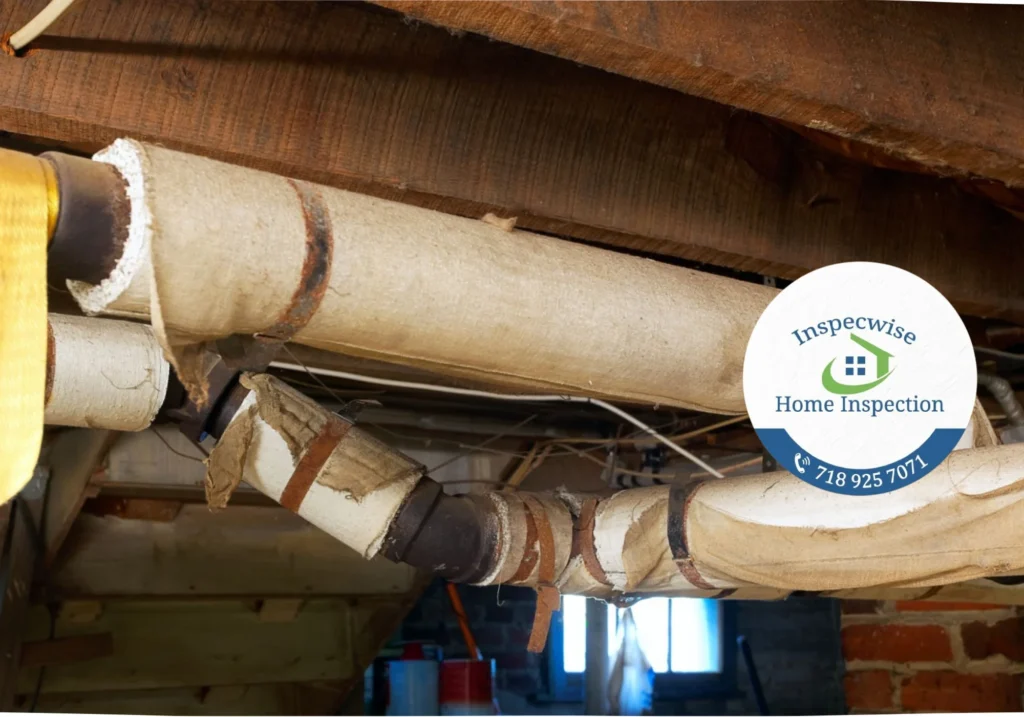
Anything built before 1978 needs to be evaluated for lead-based paint, especially where it’s peeling or flaking. Asbestos shows up regularly on old steam pipe insulation, acoustic ceiling tile, and vintage vinyl flooring we document any suspected materials clearly, since city law requires a certified assessment and abatement plan before any demolition or major renovation touches them.
Fire safety closes out the interior review: interconnected smoke and carbon monoxide alarms, fire escape windows that open without tools or keys, and in multi-family buildings self-closing entry doors, which are legally required to slow the spread of smoke through shared hallways.
Co-ops, Condos, and Multi-Family Buildings: The Financing Layer Most Checklists Skip
Buying a co-op or condo here means the inspection extends beyond the physical unit. We look at how the specific apartment interacts with shared systems risers, party walls, the building’s mechanical core because a defect in the building’s infrastructure becomes your problem the moment you close, even if it’s technically “common area.”
If you’re financing the purchase, the property itself has to clear a separate set of standards. A Home Inspection for FHA Loan NY requirements review checks things a conventional buyer might skip peeling exterior paint, handrail requirements, water heater strapping because FHA appraisers flag these items independently, and an inspection that catches them early saves a scramble right before closing.
New construction and gut-renovated units bring their own wrinkle: builder warranties. If your unit came with coverage, an 11 Month Warranty Inspection NY review, timed just before the warranty period closes, is the single best way to get the builder to fix problems on their dime instead of yours. We’ve caught roof flashing errors and HVAC installation defects this way that would have been out-of-pocket repairs two months later.
For multi-family homes in neighborhoods like Bed-Stuy, Clinton Hill, or Crown Heights, we cross-check the physical layout against the Certificate of Occupancy on file with the city. Unpermitted basement apartments and illegal room conversions are common enough that skipping this step is a real financial risk violations and stop-work orders can run into tens of thousands of dollars to clear.
Beyond the Five Boroughs: Long Island and the Hudson Valley
Buyers moving further out still deal with plenty of aging infrastructure, just in different forms older septic systems, private wells, and oil tanks that a city buyer never has to think about. A Home Inspection Huntington NY assessment, for instance, routinely turns up buried oil tanks from decades-old heating conversions that need to be documented (and sometimes remediated) before a sale can close cleanly. Buyers relocating up toward Westchester run into similar issues, and a Home Inspection White Plains NY review typically spends extra time on older septic fields and well water testing that simply don’t come up in a Manhattan condo inspection.
Choosing Who Does the Inspection
Not every inspection company approaches a building the same way, and the standards a company holds itself to matter as much as the checklist they’re running through. Reviewing a company’s approach for example, seeing how A Buyer’s Choice Home Inspection structures its reporting and communication standards is a reasonable way to understand what “thorough” should actually look like before you hire anyone.
If you want a single reference point for the full scope of what a proper home inspection checklist should cover across the five boroughs, our Home Inspection NYC page walks through service areas, report turnaround, and what’s included in a standard visit.
Frequently Asked Questions
How long does a home inspection take in NYC? Most single-unit apartments take two to three hours. A full brownstone or small multi-family building usually runs three to five hours, depending on cellar access and roof configuration.
Do I need a separate inspection for a co-op vs. a condo? No the physical inspection process is the same. What changes is the paperwork review afterward, since co-op boards and condo associations disclose building-wide information differently.
Should I still get an inspection on new construction? Yes. New buildings can have installation errors, code violations, and warranty-covered defects that only show up under a proper inspection which is exactly what an 11-month warranty inspection is designed to catch before coverage runs out.
What’s the biggest red flag in older NYC buildings specifically? Knob-and-tube wiring and Federal Pacific or Zinsco electrical panels top the list, alongside any sign of active moisture intrusion in a basement or cellar.
Can I attend the inspection myself? Yes, and we recommend it. Walking the property with your inspector gives you context for the written report that’s difficult to get any other way.
Does a home inspection include a sewer scope? Not by default. It’s a separate add-on we strongly recommend for any building with an older clay or cast-iron lateral line, especially in neighborhoods with mature street trees, since roots are a common cause of lateral damage.
How much does a home inspection cost in NYC? Pricing depends on square footage, unit count, and building age. Multi-family and townhouse inspections cost more than a single condo unit because of the added mechanical and structural scope.
What happens if the inspection finds a major issue? You typically have room to renegotiate price, request repairs before closing, or in some cases walk away from the deal, depending on how your purchase contract’s inspection contingency is written.

Why Choose Inspecwise
Inspecwise inspectors work in this city’s buildings every day, which means we’re not guessing at how a pre-war steam system or a rubble-stone foundation behaves we’ve already seen the version of it that failed and the version that held up. Every inspector on our team is fully licensed, and we bring thermal imaging and digital moisture mapping into every visit, not as an upsell, but because those tools catch things a flashlight and a ladder genuinely can’t.
We also know the paperwork side matters as much as the physical one. Our reports turn around fast, written in plain language, with photos tied directly to each finding so you’re not left decoding jargon under deadline pressure from a closing date. When something’s wrong, we tell you plainly what it means and what it’s likely to cost no inflated language, no scare tactics, just what we found and why it matters.
Serving All 5 Boroughs and Long Island: Manhattan • Brooklyn • Queens • The Bronx • Staten Island • Nassau County • Suffolk County
Call Inspecwise now: 718-925-7071
Licensed, Certified, and 100% NYC Local