Coop and condo inspection Manhattan purchases demand a different level of scrutiny than a typical single-family home inspection anywhere else in the country. When you buy into a Manhattan building, you’re not just buying an apartment you’re buying into a shared structure that might be 120 years old or two years old, with its own mechanical systems, its own board politics, and its own list of deferred maintenance that eventually becomes your problem too. We’ve walked through thousands of these units, and the pattern is always the same: the apartment itself tells half the story, and the building tells the other half.
A proper pre-purchase inspection has two jobs. First, we look inward checking the unit for active defects, unpermitted renovations, and anything that could be a safety issue down the line. Second, we look outward, at the building’s shared mechanical, structural, and financial health, because a failing boiler or a crumbling facade three floors up can trigger an assessment that hits your bank account just as hard as anything wrong inside your own four walls. Doing this well means knowing the difference between a pre-war brownstone, a post-war concrete tower, and a glass-curtain luxury high-rise because each one fails in its own predictable way, and each one carries its own set of Department of Buildings (DOB) compliance risks.
Co-op vs. Condo: Why the Legal Structure Changes What We Inspect For
The legal difference between a co-op and a condo isn’t just paperwork it actually changes how we approach the physical inspection. Buy a condo, and you own real property: a deed to your specific unit plus a fractional share of the building’s common elements. Buy into a co-op, and you’re technically buying shares in a corporation, which then grants you a proprietary lease on your apartment. That distinction shifts who’s on the hook for what, and it changes what we flag as “your problem” versus “the building’s problem.”
Where your responsibility ends and the building’s begins. A co-op’s proprietary lease typically draws the line at the finished wall surface. Everything behind the plaster or drywall branch plumbing, waste stacks, risers, structural joists, main electrical conduit usually belongs to the corporation. Condos often draw a tighter circle, holding the unit owner responsible for plumbing inside their own walls and for whatever heating or cooling equipment services just their unit. In our experience, buyers are frequently surprised to learn which side of that line their in-wall pipes or PTAC unit falls on, and it’s a conversation we have on nearly every walkthrough.
Layout changes and board sign-off. Co-op boards keep tight control here. During the inspection, we compare the actual layout against the building’s official floor plans, because an illegally relocated kitchen or an unpermitted bathroom expansion is more than a cosmetic issue if the previous owner never got board approval and a DOB Letter of Completion, the board can legally force the new shareholder to rip it all out and pay for it themselves. This is one of the more expensive surprises we see, and it’s entirely avoidable with the right due diligence upfront.
Who pays when the building’s systems fail. When shared infrastructure goes down, a condo board usually issues a direct capital assessment, while a co-op corporation might instead refinance the underlying mortgage or raise monthly maintenance. Either way, the money comes from owners. That’s why we look past the apartment door for early warning signs masonry cracking on the facade, an elevator motor that’s straining, a boiler that’s clearly on borrowed time because those are the things that turn into seven-figure capital calls a year or two down the road.
Building Age Changes Everything: Pre-War, Post-War, and Modern Construction
Manhattan has one of the most architecturally diverse housing stocks anywhere, and we adjust our approach depending on when a building went up. Pre-war buildings generally anything built before World War II are known for thick plaster walls and heavy timber or concrete-encased steel frames. They’re also known, in our experience, for a very consistent list of aging problems.
In a pre-war unit, we expect to find outdated wiring tucked behind plaster sometimes knob-and-tube, sometimes old cloth-insulated conductors neither of which was designed for modern electrical loads. Older Manhattan buildings often still have galvanized steel supply pipes as well, and after decades of service these corrode from the inside, choking off water pressure and leaching rust into the tap water. We also routinely find wood-joist subfloors with some sagging or soft spots, usually traced back to a slow radiator leak nobody noticed for years.
Post-war buildings, roughly from the late 1940s through the 1980s, swapped masonry for reinforced concrete and cinder block. They’re structurally solid, but the thin concrete floor slabs transmit impact noise between units far more than people expect something worth knowing before you buy above a family with young kids. Plumbing in these buildings is a mix of cast-iron waste lines and copper supply lines that are now reaching the end of their service life; pinhole leaks and galvanic corrosion at metal transitions are among the issues we commonly see when we open up an access panel in one of these buildings.
Modern luxury high-rises built from the 1990s onward look flawless on the surface but bring their own quirks. A recurring issue we find is missing or improperly installed fire-stopping around vertical service chases, which matters far more than most buyers realize during an actual fire event. These buildings also lean heavily on individual PTAC units or more complex VRF systems, and if the exterior louvers on a PTAC weren’t flashed correctly during installation, wind-driven rain gets behind the drywall and grows mold where nobody’s looking. Buyers researching a unit in one of these towers may want to pair a standard walkthrough with a dedicated Home Electrical Inspection, since modern buildings still have their share of panel and circuit issues despite the newer construction.
Why the Building’s Mechanical Systems Matter as Much as Your Own
A home inspection Manhattan buyers rely on has to look at how the whole building’s infrastructure connects to your unit, because your daily comfort heat, water pressure, hot water depends almost entirely on centralized systems you don’t control.
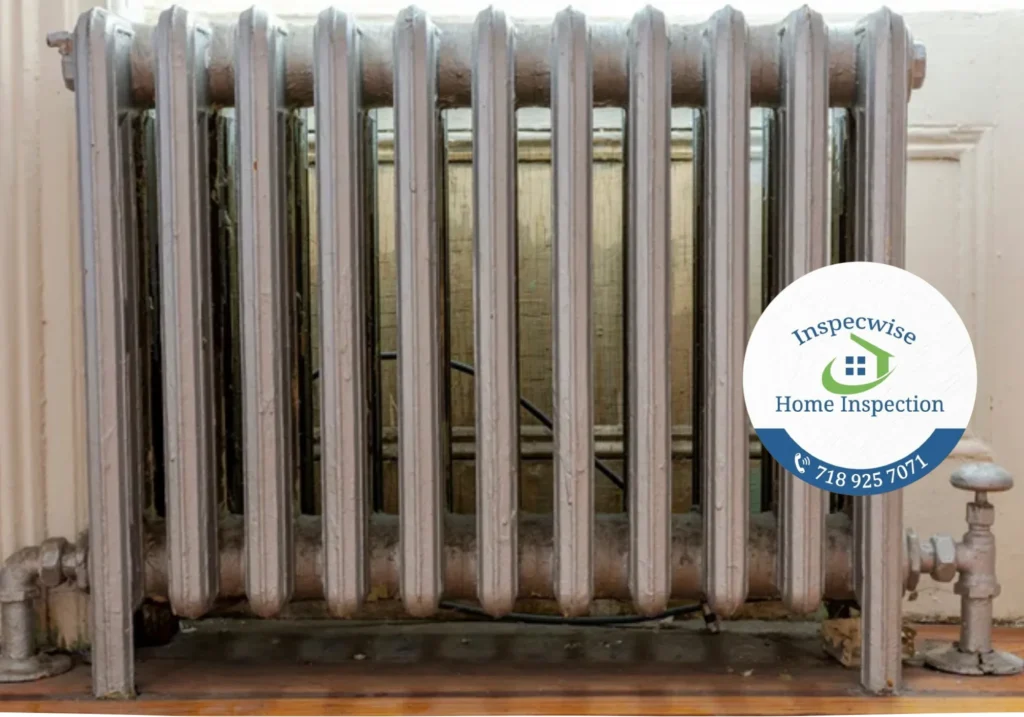
Heating in Manhattan is dominated by low-pressure steam boilers or large hydronic loops, with steam traveling up risers to cast-iron radiators or recessed convectors. We check every radiator valve, air vent, and union for weeping or old mineral buildup, because a bad air vent leaves an apartment cold no matter how high the thermostat is set, and a stuck trap causes that banging “water hammer” noise that keeps people up at night.
Water pressure is its own science in a high-rise. City water pressure typically only pushes water up to about the fifth or sixth floor on its own, so taller buildings rely on a roof tank or a basement booster pump system. Apartments near the top of a gravity-fed building often have noticeably weaker pressure simply because they’re only a few feet below the tank. We run a multi-fixture flow test shower, sink, and kitchen tap running together with a pressure gauge, because a single running faucet will never reveal a real-world pressure problem.
Electrical capacity is a quieter issue but one of the more consequential ones. Plenty of pre-war and post-war co-ops were wired for just 30 to 60 amps per apartment, which was fine decades ago and is not fine now that a typical household runs multiple computers, a home theater, an induction cooktop, and window or split AC units closer to 100 amps of real demand. We open the distribution panel and check for double-tapped neutrals, breakers that don’t match the wire gauge behind them, and any sign of arcing on the bus bars. If the building’s risers are already maxed out, the board may simply refuse to let you upgrade your panel, which quietly kills any plan for an in-unit washer/dryer or a modern ductless AC system. This is exactly the kind of finding that makes a standalone Home Electrical Inspection worth adding for anyone buying into an older building.
Hidden Health Hazards Behind the Walls
Fresh paint hides a lot in a Manhattan apartment, and part of our job is looking past it with the right tools thermal cameras, moisture meters, and air-sampling equipment where warranted.
Anything built before the 1978 federal phase-out is likely to have lead-based paint somewhere in its layers. It’s generally stable when intact, but friction surfaces classic double-hung window tracks especially can shed lead dust every time the window is opened. Pipe insulation, old floor tile adhesive, and ceiling plaster in pre-war buildings frequently contain asbestos as well, and when we spot damaged or friable material, we flag it clearly, because any future renovation will need proper abatement and permitting.
Windows take a beating from wind and rain in this city, and we check the caulking, panning, and weep holes on every one. Failed glass units lose their insulating gas fill and fog up permanently, but the more serious finding is when masonry failure lets water bypass the flashing entirely and soak into the wall cavity that’s when we start finding hidden mold growth behind baseboards, sometimes well before it’s visible anywhere else. Buyers who’ve had water staining or a musty smell in a unit often ask us to schedule a Home Mold Inspection alongside the general walkthrough, and honestly, it’s a smart pairing whenever there’s any history of leaks.
Flooring and floor levelness tell their own story too. We check hardwood historic parquet or newer engineered oak for buckling or crowning, and we run a laser level to map any slope across the apartment. A slight dip is normal in a century-old building that’s settled over time; a sharp drop over a short span usually means a compromised joist or a wall that was removed downstairs without proper structural support.
Local Laws Every Manhattan Buyer Should Know About
Buying into a Manhattan building means inheriting your share of whatever compliance issues, unfiled permits, and looming capital costs already exist whether or not you knew about them at closing.
Local Law 11, officially the Facade Inspection & Safety Program, requires buildings over six stories to have a licensed engineer or architect physically inspect the exterior every five years, rating it Safe, SWARMP, or Unsafe. An Unsafe rating means a sidewalk shed goes up almost immediately, and those sheds aren’t cheap monthly rental fees add up fast, and that’s before the actual facade repair, which can run into the millions. We always check a building’s current FISP filing status on the DOB NOW Public Portal before finalizing a report, because inheriting an active facade assessment is one of the more expensive surprises a new owner can face.
Local Law 152 requires periodic inspection of exposed gas piping every four years. If an inspection turns up uncertified piping, corrosion, or an active leak, the gas utility can lock out the building’s meter entirely which means no cooking gas and no boiler until the system is fully repaired and repermitted, sometimes for months. Checking that a building has a current Local Law 152 certificate on file is a small step that avoids a genuinely miserable outcome.
Local Law 97, part of the city’s Climate Mobilization Act, caps carbon emissions for buildings over 25,000 square feet, with tighter limits every few years. Buildings that miss their targets face real financial penalties, and a lot of older co-ops and condos are now mid-retrofit swapping steam boilers for electric heat pumps, installing high-efficiency windows, upgrading building management systems specifically to avoid those fines. Any serious pre-purchase evaluation should factor in these upcoming energy compliance costs, because they’re not optional and they’re not going away.
The Tools We Actually Use During an Inspection
A flashlight and an outlet tester don’t cut it in a dense Manhattan high-rise. We rely on a more advanced toolkit to see what’s actually happening inside the walls.
Thermal imaging lets us map subtle temperature differences across walls and ceilings, which is often the first clue to a hidden leak from the unit upstairs, missing insulation in an exterior wall, or an overloaded electrical connection heating up inside a plaster ceiling. Once thermal imaging flags something, a pinless moisture meter confirms whether it’s an active leak or just an old, dry stain without putting a single hole in the wall.

For gas lines, soap-bubble testing simply isn’t practical across the length of pipe running through a Manhattan apartment, so we use electronic gas detectors sensitive enough to catch a leak at just a few parts per million, tracing lines behind stoves and through service chases. And on the electrical side, a circuit analyzer lets us apply a real load to a circuit and measure voltage drop, which catches loose connections and undersized wiring long before they become a fire risk something a standard outlet tester will never reveal.
What We Look at Beyond Your Front Door
Buying into a Manhattan building means taking on a financial stake in the whole structure, not just your unit, so a complete inspection has to look at the common areas and the building’s records too.
For larger purchases, we often recommend expanding the scope with a dedicated Commercial Inspection Manhattan evaluation, which covers heavy building systems like commercial chillers, rooftop cooling towers, fire pumps, and backup generators in far more depth than a standard residential walkthrough. Catching early cavitation in a fire pump or scale buildup in a chiller is the kind of finding that can save a buyer from an unexpected multi-million-dollar capital project down the line.
We also walk the general common areas the roof membrane, drainage around roof drains, the sub-basement for signs of water intrusion, and the fire escapes for structural alignment. Cracking in basement foundation walls or rust on structural steel columns is a signal worth taking seriously, even when it doesn’t affect your unit directly.
All of that physical information gets cross-referenced against the building’s financials, board minutes, and reserve study. An aging roof and a tired elevator system paired with an underfunded reserve is a near-guarantee of a coming assessment. A building with a healthy reserve and solid insurance, on the other hand, is in a much better position to handle its next major repair without hitting owners for surprise money. Combining the physical inspection with a real look at the numbers is really the only way to get the full picture before you sign anything.
What Buyers, Sellers, and Investors Should Take Away From This
If you’re buying, the inspection is your leverage it tells you what to negotiate, what to budget for, and what questions to ask the board before you’re contractually committed. If you’re selling, addressing obvious issues (a weeping radiator valve, an outdated panel, visible water staining) before listing tends to smooth out the whole process and avoid last-minute renegotiation. And if you’re an investor evaluating a multi-unit or mixed-use building, pairing a residential-style inspection with a Commercial Property Inspection gives you a much fuller risk picture, especially where ground-floor retail or shared commercial systems are involved.
It’s also worth remembering what an inspection can’t do. We’re not opening walls, testing every outlet in the building, or predicting exactly when a 40-year-old boiler will fail we’re identifying risk and giving you the information to make an informed decision, not a guarantee against every future repair.
Frequently Asked Questions
How long does a coop or condo inspection in Manhattan take? Most single-unit inspections run two to three hours, depending on the apartment’s size and age. Older pre-war units with more systems to check steam radiators, older wiring, window conditions tend to run on the longer side.
Do I need a separate inspection for the building, or just my unit? For a standard purchase, a thorough inspector will already look at accessible common areas and shared systems as part of the unit inspection. Larger buildings, mixed-use properties, or investment purchases usually warrant a more detailed Commercial Inspection Manhattan on top of that.
Will my co-op board let an inspector into common areas like the boiler room or roof? It varies by building. Some superintendents are happy to walk an inspector through mechanical rooms; others require advance notice or management approval. We always request access ahead of time to avoid delays on inspection day.
Should I get radon testing done along with a general inspection? It’s a good idea, especially for lower-floor units or buildings with a history of basement moisture. Pairing radon testing NYC with the general inspection means you’re not scheduling a second visit later if elevated levels turn up.
What’s the biggest issue you find in pre-war Manhattan apartments? Outdated electrical capacity is probably the most common one a lot of these units were wired decades before anyone owned an air conditioner, let alone a home office setup, and the panel simply wasn’t built for it.
Can an inspection reveal problems the seller didn’t know about? Yes, regularly. Slow leaks behind walls, undersized wiring, and building-wide issues like a pending facade assessment are things sellers often genuinely don’t know about, especially in buildings with passive management.
Is a sewer scope necessary for an apartment inspection? For a single unit inside a large building, it’s less common, but it becomes relevant for lower-level units, ground-floor commercial space, or townhouse-style co-ops with their own lateral line a sewer scope inspection can save a buyer from an expensive surprise underground.
What happens if the inspection finds unpermitted renovations? We document what we see and note the discrepancy from official floor plans. From there, it’s on the buyer’s attorney and the board to sort out whether permits need to be filed retroactively or whether the work needs to be reversed before the sale closes.
Why Choose Inspecwise
Inspecwise has spent years inspecting the full range of Manhattan housing stock century-old brownstones, mid-century concrete towers, and brand-new glass high-rises and that range matters, because the issues in each one are genuinely different. Our inspectors bring the same forensic toolkit to every job: thermal imaging, electromagnetic moisture mapping, and digital circuit analysis, so what we hand you isn’t a checklist but a real, evidence-backed picture of the apartment and the building behind it. Every inspection is followed by a detailed, plain-language report built to give you actual leverage at the negotiating table, not just a pass/fail summary. When you’re making one of the largest financial decisions of your life in one of the most complex real estate markets in the country, that level of local knowledge and technical depth is what protects your investment.
Serving All 5 Boroughs and Long Island: Manhattan • Brooklyn • Queens • The Bronx • Staten Island • Nassau County • Suffolk County
Call Inspecwise now: 718-925-7071
Licensed, Certified, and 100% NYC Local