Protect your commercial property from hidden roof leaks before they become costly repairs.
Inspecwise uses advanced infrared thermal imaging to detect trapped moisture beneath commercial roofing systems without damaging the roof. Whether you’re buying a commercial property, planning capital improvements, or investigating a leak, our certified inspectors deliver detailed reports that help you make confident, well-documented decisions.
✓ Licensed Commercial Inspectors
✓ Infrared Thermal Imaging
✓ Investor & Lender Reports
✓ Serving NYC & Long Island
✓ Fast Turnaround
Why Commercial Roof Infrared Moisture Scanning Matters
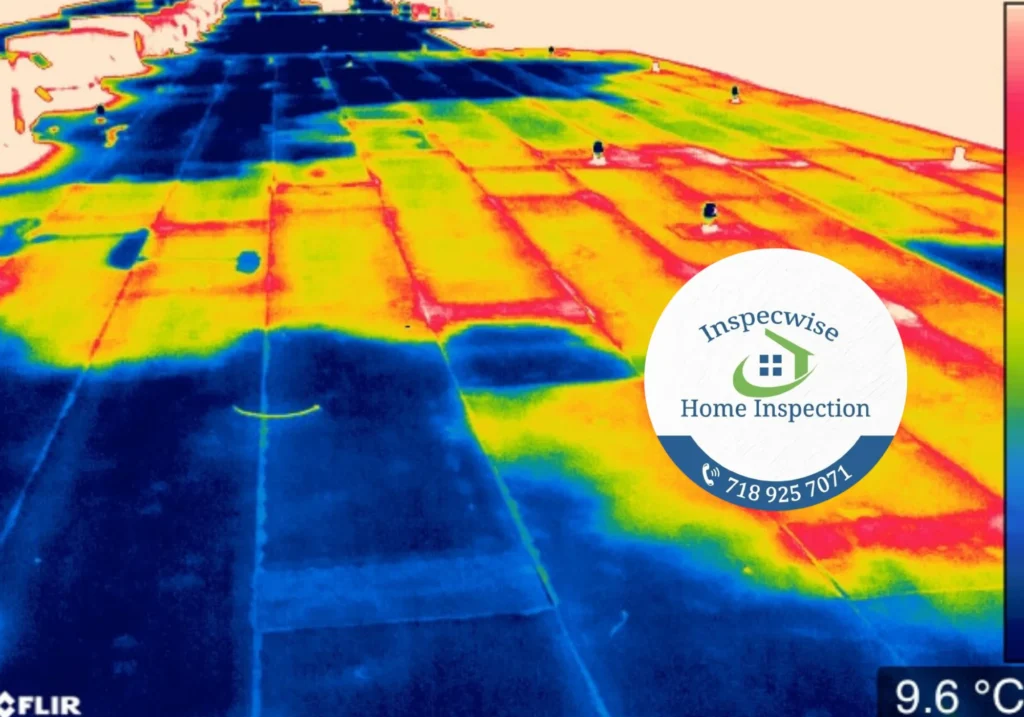
A roof can look completely fine from below and still be failing underneath. Hidden leaks travel sideways through insulation long before they ever show up as a ceiling stain, and by the time a soft spot or a drip appears, the damage is usually well established. Saturated insulation loses most of its ability to hold heat, which quietly drives up energy costs long before anyone notices a problem. Left unaddressed, trapped moisture leads to mold growth, structural decking damage, and eventually an unplanned full roof replacement instead of a small, targeted repair. If mold is already suspected, pairing a moisture scan with a Commercial Mold Inspection gives a complete picture of both the water source and its downstream effects. Catching the problem early, while it’s still a patch job, is what makes this inspection worth scheduling before small damage becomes a capital expense.
What Is Commercial Roof Infrared Moisture Scanning?
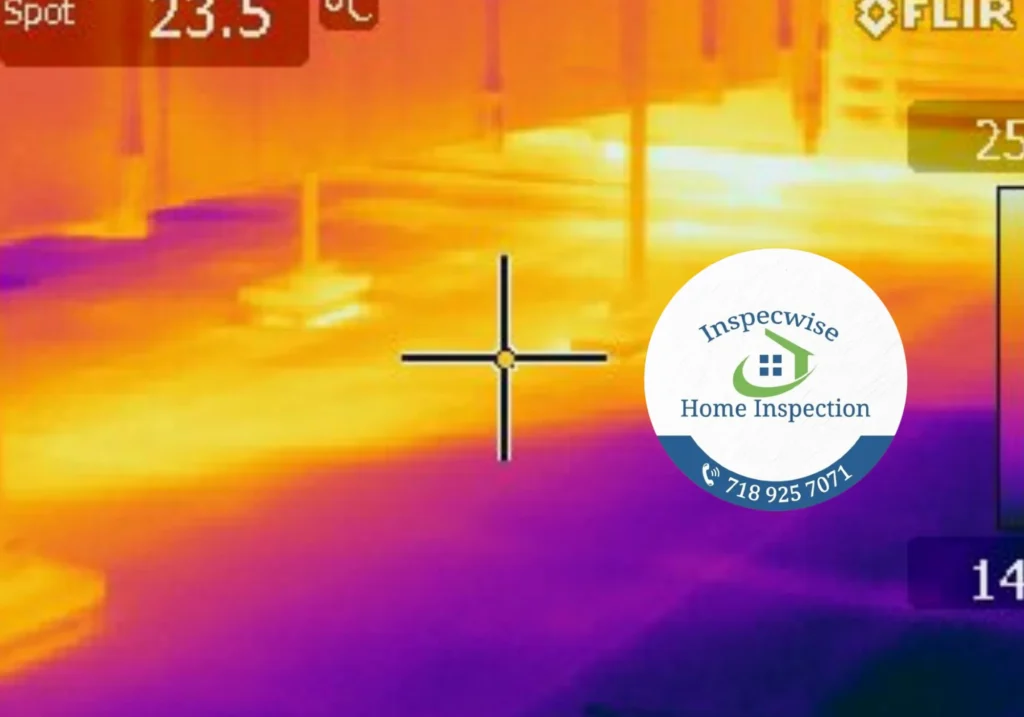
Roof moisture scanning is a non-destructive inspection method that uses thermal imaging cameras to map temperature differences across a roof surface. Wet insulation retains heat longer than dry insulation after sunset, so trapped moisture shows up as a distinct thermal signature even though the roof looks completely normal from above. A certified thermographer walks the roof, or flies it by drone, after dark once the sun’s heat has faded, then photographs those temperature patterns to build a picture of exactly where water has gotten in.
This is fundamentally different from a standard Commercial Roof Inspection, which relies on visual observation of the membrane, flashing, and drainage. Thermal scanning goes underneath what a visual walk-through can see, identifying saturated insulation, hidden leaks around rooftop penetrations, and moisture migrating between roof layers long before any of it becomes visible as a ceiling stain or a soft spot underfoot. Insulation type plays a role in how the scan reads: some materials show clear, well-defined hot spots, while others require a more sensitive camera and a slower pass to catch subtler temperature shifts. Either way, the goal is the same a full picture of moisture conditions without cutting into the roof to get it.
Commercial Roof Moisture Scanning Cost
Pricing for a commercial roof moisture scan varies by project, and a handful of factors drive that variation more than any others.
Roof size is the starting point: larger roofs take longer to scan and generate more data to review, though the per-square-foot rate typically drops as total area increases. Accessibility matters just as much. A roof reachable by a service stair or freight elevator is straightforward to inspect; a roof that requires scaffolding, a bucket truck, or rigging to get equipment up top adds real time and cost to the job. Building height and roof complexity play a similar role a simple single-level roof scans faster than one with multiple levels, setbacks, or heavy rooftop equipment crowding the surface.
Whether the project calls for drone scanning versus an on-foot survey also changes the approach and the price, since drones are efficient for large open roofs but add less value on small, tightly packed urban roofs. Insulation type factors in too, as some materials produce a clean, easy-to-read thermal signature while others take longer to interpret accurately. The level of moisture verification required affects cost as well physical core samples and moisture meter readings take extra time on-site but strengthen the confidence of the final report. Reporting requirements are the last major variable: a short summary costs less to produce than a full engineering report with capital planning built in for lender or investor review.
| Factor | Impact on Cost |
|---|---|
| Roof Size | High |
| Building Height | Medium |
| Roof Complexity | High |
| Drone Scanning | Medium |
| Moisture Verification | Medium |
| Reporting Level | High |
Request a Commercial Roof Moisture Scan
When Do You Need Commercial Roof Moisture Scanning?
A moisture scan makes sense at several points in a commercial property’s life. It’s standard due diligence before buying a commercial building, since a certified thermal report gives a buyer real evidence to negotiate on price or request a credit if the roof turns out to be compromised. It’s also the right move if you’re already seeing signs of a roof leak, since thermal imaging pinpoints where water is traveling rather than just where it’s dripping through, and those two points are often in different locations entirely.
Beyond acute problems, scanning fits naturally into preventive maintenance schedules, reserve studies, and long-term capital planning a scan every year or two lets asset managers catch small issues while they’re still cheap to fix instead of waiting for a bigger failure. It’s also commonly required for insurance documentation, and it should always happen before a roof replacement or before installing rooftop solar, since covering a hidden leak with a new membrane or a solar array turns a minor repair into a major, expensive teardown down the road. If you’re weighing a purchase, pairing a moisture scan with a broader Commercial Building Inspection NYC gives you both the roof-specific data and the whole-building context you need to move forward with confidence.
Why Infrared Beats Guesswork
A standard roof inspection is a valuable, visual-only check. It’s excellent at catching surface defects but it stops at the membrane. Infrared moisture scanning picks up exactly where that visual check leaves off, finding problems no amount of careful looking can reveal.
| Commercial Roof Inspection | Roof Moisture Scan |
|---|---|
| Visible defects | Hidden moisture |
| Membrane condition | Wet insulation |
| Flashing | Thermal anomalies |
| Surface damage | Hidden leaks |
Traditional inspections only identify visible roof defects. Infrared moisture scanning detects hidden moisture beneath the roofing membrane before any visible damage appears. That difference matters because it’s non-destructive, faster than cutting exploratory test holes into the roof, and it leads directly to lower repair costs, better long-term capital planning, and more accurate due diligence than a visual check alone can support. We see the gap between the two approaches most clearly on older properties a retail strip inspected under a Commercial Building Inspection Bronx project, for instance, can look sound from the sidewalk while still carrying years of trapped moisture under a roof that’s been patched more than once.
Our Commercial Roof Infrared Moisture Scanning Process
Step 1 — Property Review We start by reviewing building plans, roof age, and any known history of leaks or repairs, so the scan is targeted rather than generic.
Step 2 — Infrared Roof Scan Our thermographer scans the roof after dark using handheld thermal cameras or drone-mounted equipment, depending on the size and layout of the property.
Step 3 — Moisture Verification Any thermal anomaly gets confirmed with a moisture meter or a small core sample, so the final report reflects confirmed water rather than a temperature difference alone.
Step 4 — Engineering Analysis Our team reviews the verified findings against the roof’s construction, age, and insulation type to determine severity, likely cause, and next steps.
Step 5 — Detailed Report You receive a complete report with thermal maps, verified moisture locations, and clear repair recommendations you can act on right away.
What You Receive
Every Inspecwise commercial roof moisture scan comes with a full set of deliverables, not just a verbal summary at the end of the visit. That includes infrared images of the roof surface, moisture maps showing exactly where water has been detected, and photographs documenting current roof conditions throughout the property. You’ll also get repair recommendations prioritized by urgency, written observations on overall roof condition, and confirmation of moisture verification results from core samples or meter readings taken on-site.
For larger transactions, the full engineering report and executive summary are built to stand up to lender and investor scrutiny the same standard we apply across every Property Condition Assessment NY we produce, so roof findings slot directly into a broader due diligence package rather than existing as a standalone document that needs separate interpretation. We also flag any conditions worth a closer look from another trade, since a roof issue can sometimes point to a related problem elsewhere in the building envelope or its mechanical systems.
Commercial Properties We Inspect
Commercial roof moisture scanning applies across nearly every property type in New York City, though the approach shifts depending on the building. Office towers in Manhattan often feature rooftop amenity decks, green roofs, or heavy mechanical equipment that complicate a thermal read and require an experienced eye to separate real moisture signatures from equipment heat and landscaping mass. A green roof in particular can bury a leak under soil and vegetation for months before it ever surfaces as a ceiling stain, which is exactly the kind of hidden problem this inspection is meant to catch early.
Industrial Warehouse Inspection projects tend to involve large, open roof surfaces well suited to drone scanning, though heavy machinery vibration and unusual temperature zones inside the building can affect results and need to be accounted for during analysis. A warehouse roof that reads perfectly clean on a first pass can still hide a slow leak near a rooftop unit or a drain, which is why verification matters as much as the scan itself. Distribution centers in particular tend to have flat, low-slope roofs with dozens of penetrations for exhaust fans and skylights, and every one of those penetrations is a place water can work its way in over time.
Retail corridors and shopping plazas present a different challenge entirely. Roofs on these properties tend to get modified repeatedly over the years to accommodate new tenants, restaurant exhaust hoods, and utility tie-ins, and each of those modifications is a potential entry point for water. That history means a section-by-section read matters more here than for almost any other property type, rather than a single blanket scan treating the whole roof as one uniform surface.
Brownstones, mixed-use buildings, and apartment properties round out the list, and they bring their own set of complications. Multiple roof levels, tenant foot traffic, and unapproved rooftop modifications are all common on a Commercial Building Inspection Brooklyn project. Residents and building staff often make small changes to a rooftop over the years a satellite dish mount, a grill station, a storage shed and each one is a potential puncture point that a standard walk-through can easily miss.
NYC Compliance Considerations
Wet roof insulation isn’t just a maintenance issue in New York City it’s a compliance issue. Insulation that has absorbed water loses much of its ability to retain heat, which pushes HVAC systems to work harder and drives energy costs up; a building already scheduled for a Commercial HVAC Inspection often benefits from a roof moisture scan at the same time, since the two systems are more connected than they look. That energy loss directly affects standing under the NYC Energy Conservation Code, which sets minimum insulation and energy performance standards for commercial buildings across the five boroughs.
It also matters for NYC Local Law 97, which penalizes larger buildings for exceeding carbon emissions limits. A building losing energy efficiency through saturated insulation is working against its own compliance numbers every year the problem goes unaddressed, and those penalties only grow over time as thresholds tighten. Saturated insulation can also add unexpected weight to a roof deck, which is relevant to structural load rules enforced by the NYC Department of Buildings, since some codes restrict how many roof layers a building can legally carry. Catching moisture early with a scan keeps a building on the right side of all three at once energy code, emissions law, and structural load rather than discovering a compliance gap during a filing deadline when there’s little time left to fix it.
Why Choose Inspecwise
Inspecwise brings certified inspectors and infrared technology together with real, on-the-ground experience across New York City’s commercial building stock, from prewar structures to modern high-rises. Our reports are built for action: clear findings, prioritized repair recommendations, and a turnaround fast enough to support real estate deadlines rather than slow them down. That combination of technical accuracy and local market knowledge is what asset managers and lenders are actually looking for when they order a report ahead of a closing date.
We work regularly with investors, brokers, and asset managers who need due diligence they can rely on, which is why our commercial roof moisture scans are structured the same way as our broader Commercial Property Inspection work thorough, well documented, and built to hold up under scrutiny from lenders, insurers, and buyers alike. Investor-focused reporting and fast turnaround aren’t add-ons for us; they’re the baseline for every commercial job we take on, whether it’s a single-building scan or part of a multi-property portfolio review.
Areas We Serve
Inspecwise performs commercial roof moisture scanning across Manhattan, Brooklyn, the Bronx, and Staten Island, as well as Nassau and Suffolk counties on Long Island. Queens is one of our busiest service areas, with a mix of retail corridors, warehouses, and older mixed-use buildings that regularly need infrared verification the kind of work we cover under Commercial Building Inspection Queens and the same certified process applies no matter which borough or county the property is in.
Frequently Asked Questions
What is commercial roof moisture scanning? It’s an infrared inspection method that detects water trapped inside a roof assembly, identifying problems that aren’t visible from a standard walk-through.
How does infrared roof moisture scanning work? A thermal camera measures temperature differences across the roof surface. Wet insulation holds heat longer than dry insulation after sunset, which shows up clearly on camera.
Can thermal imaging detect every roof leak? It detects trapped moisture very reliably, but results are always confirmed with core samples or moisture meters to rule out false readings from equipment heat or reflective surfaces.
How much does commercial roof moisture scanning cost? Cost depends on roof size, accessibility, building height, insulation type, and the level of reporting and verification required for the project.
Do you use drones? Yes, for larger or harder-to-access roofs. Smaller or tightly packed urban roofs are often scanned on foot instead.
What does the inspection report include? Infrared images, moisture maps, photographs, repair recommendations, and an engineering summary of roof condition.
How long does the inspection take? It depends on roof size and complexity, but most commercial scans are completed in a single night visit.
How often should a commercial roof be scanned? Every one to two years for preventive maintenance, or immediately before a purchase, roof replacement, or solar installation.
Is commercial roof moisture scanning worth it before buying a property? Yes. A thermal report gives you documented, third-party evidence of roof condition before closing, which is often enough to negotiate price or request a seller credit if moisture is found.
Schedule Commercial Roof Moisture Scanning in NYC
Whether you’re purchasing a commercial building, managing an investment portfolio, investigating a roof leak, or planning future capital improvements, Inspecwise provides detailed infrared moisture scanning that helps you make informed decisions with confidence.
GET IN TOUCH
Schedule a Visit
Serving All 5 Boroughs and Long Island: Manhattan • Brooklyn • Queens • The Bronx • Staten Island • Nassau County • Suffolk County
Call Inspecwise now: 718-925-7071
Licensed, Certified, and 100% NYC Local