Inspecwise provides professional commercial inspection services throughout Manhattan for buyers, investors, owners, property managers, landlords, tenants, and lenders evaluating commercial real estate. Acquiring or leasing commercial property in Manhattan involves substantial financial exposure, and the borough’s building stock, much of it pre-war, converted, or adapted for uses it wasn’t originally designed for, creates inspection considerations that don’t apply in most other markets. A commercial inspection evaluates the building systems and visible conditions that affect how a property performs and what it will cost to maintain, giving buyers and other stakeholders a clearer picture of property condition before a closing, lease signing, or major capital decision. If you’re searching for a commercial inspector in Manhattan, this page explains what our inspections cover, how the process works, and what to expect from a report.

Commercial Inspection Manhattan: Why It Matters Before You Buy or Lease
A commercial property transaction in Manhattan typically represents a significant capital commitment, and the condition of the asset directly affects its long-term value. Hidden defects and deferred maintenance are common in a market where buildings have passed through multiple owners, tenant build-outs, and renovations over many decades. A roof nearing the end of its service life, an electrical system undersized for current tenant demand, or a boiler plant that has been patched rather than replaced can all translate into unplanned capital expenses shortly after closing.
A commercial inspection gives buyers and investors an objective, documented account of observable conditions before they commit. That documentation supports several practical outcomes: identifying repair priorities, informing negotiations over price or repair credits, and helping a buyer or tenant plan for near-term and long-term capital expenditures. For owner-occupants and businesses, an inspection can also flag conditions that could disrupt operations, such as an aging HVAC system that struggles during peak season or a plumbing system prone to backups, before those issues interrupt business continuity. For property managers and landlords, a periodic inspection supports maintenance planning and helps establish a documented condition baseline for the asset.
What Does a Commercial Inspection in Manhattan Cover?
A commercial inspection is a visual, non-invasive evaluation of a property’s major systems and accessible areas. The scope depends on the property type, size, and the agreed inspection agreement, but a typical Manhattan commercial inspection addresses the following areas.
Structural Components and Foundation
Inspectors evaluate visible structural elements, including foundation walls, load-bearing columns, floor framing, and masonry, for signs of settlement, cracking, or moisture-related deterioration. In Manhattan’s older buildings, this often includes closer attention to masonry bearing walls and any visible signs that a structure has shifted over time.
Roof and Exterior Conditions
Roofing systems, parapets, flashing, and exterior drainage are assessed for wear, ponding, and points of water entry. Flat roofs and built-up membrane systems, common on Manhattan commercial buildings, are examined for membrane condition and drainage adequacy. For a deeper evaluation of roofing-specific concerns, including membrane life expectancy and drainage design, our commercial roof inspection service goes beyond what a general walkthrough covers.

Electrical Systems
Inspectors evaluate service panels, visible wiring, grounding, and overall electrical capacity relative to the building’s apparent use. Older Manhattan commercial buildings frequently carry electrical infrastructure that was adequate decades ago but is undersized for modern tenant loads, server equipment, or HVAC demand.
Plumbing Systems
Supply lines, drainage, water heating equipment, and visible plumbing conditions are reviewed for leaks, corrosion, and material type. Pre-war buildings in particular may show a mix of original and replaced piping, which affects both water quality and long-term maintenance planning.
HVAC and Mechanical Systems
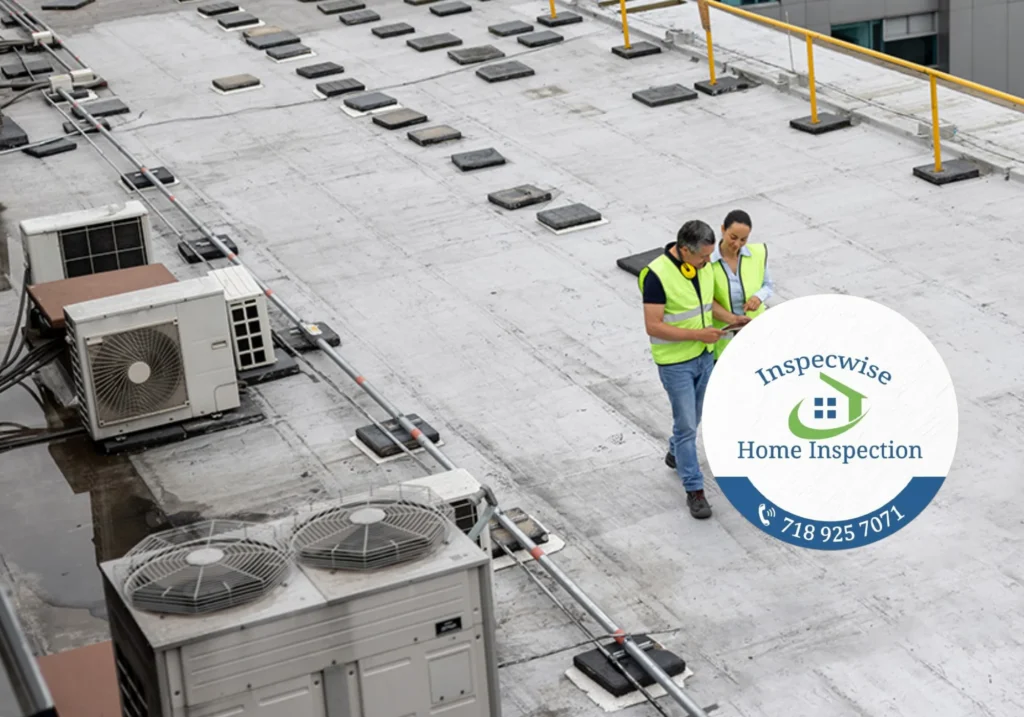
Heating, cooling, and ventilation equipment, including rooftop units, boilers, and chillers where accessible, is evaluated for visible condition, apparent age, and operational function within the scope of the inspection. For buildings where HVAC condition is a central concern, our commercial HVAC inspection service provides a more detailed system-level evaluation.
Fire and Life Safety Systems
Inspectors visually review fire and life safety components, including sprinkler coverage, standpipes, fire alarm devices, and emergency lighting and egress paths, as visible and accessible. This review does not substitute for a formal fire safety inspection or code compliance certification.
Elevators and Vertical Transportation
In a vertical market like Manhattan, elevators and other vertical transportation systems are essential to a building’s function. Inspectors note visible condition and operational performance during the inspection; a full mechanical or engineering evaluation of elevator equipment is outside the scope of a standard commercial inspection and, where warranted, should be performed by a licensed elevator contractor.
Basements, Drainage and Moisture Conditions
Basement and below-grade areas are checked for moisture intrusion, drainage adequacy, and visible signs of past water damage, a common concern in Manhattan’s dense below-grade construction. Where moisture conditions suggest a risk of hidden fungal growth, our commercial mold inspection service provides specialized testing beyond the scope of a standard visual inspection.
Commercial Inspection vs. Other Property Evaluations
| Evaluation | Primary Purpose | Typical User | Focus |
|---|---|---|---|
| Commercial Inspection | Property condition and visible building-system issues | Buyers, owners, investors | Physical condition |
| Property Condition Assessment (PCA) | Broader physical and financial due diligence, scoped to standards such as ASTM E2018 | Investors, lenders | Condition plus capital planning |
| Home Inspection | Residential property condition | Home buyers | Residential systems |
| NYC DOB Inspection | Government inspection and code enforcement | Property owners, public authority | Code compliance and enforcement |
These evaluations serve different purposes and aren’t interchangeable. A commercial inspection focuses on physical condition; a Home Inspection NYC evaluation follows a similar approach for residential property but with a different systems focus and regulatory framework. A PCA typically follows a defined standard and can incorporate financial and capital-planning analysis beyond a standard commercial inspection’s scope. NYC Department of Buildings inspections are a separate government function tied to code enforcement, not a private due-diligence service.
Why Choose Inspecwise for Commercial Inspection Manhattan
Inspecwise brings together the credentials, coverage, and turnaround commercial buyers and landlords actually need to make a decision with confidence.
- Licensed NY Inspector. Our inspectors are licensed in New York State, meeting the state’s requirements for professional property inspection.
- InterNACHI Certified. Every inspector holds InterNACHI certification, backed by ongoing training in commercial building systems.
- Commercial Specialists. We focus on commercial and mixed-use properties, not just residential walkthroughs, so our inspectors know what to look for in office buildings, retail space, multifamily assets, and industrial properties alike.
- Same-Day Scheduling. We work to accommodate tight closing and lease timelines, including same-day scheduling where availability allows.
- Fast Report Turnaround. Clients receive a detailed digital report promptly after the inspection, so findings are available in time to inform negotiations.
- Detailed Digital Reports. Reports are organized by building system and supported by photo documentation for every finding, making them easy to review and share with attorneys, lenders, or partners.
- Serving NYC & Long Island. We inspect commercial properties throughout Manhattan and the rest of New York City, as well as Long Island, giving us a working familiarity with how building stock and system age vary from one area to the next, including our work in Queens through our Commercial Inspection Queens service.
- Competitive Pricing. Pricing is scoped to the property’s size and complexity rather than a flat rate, so you’re not overpaying for a small storefront inspection or underscoped for a large office building.
- Thousands of Inspections Completed. Our team has completed a large volume of residential and commercial inspections across the NYC metro area. (Confirm the exact figure with your team before this goes live, so the claim is accurate and defensible if a client asks.)
These characteristics matter for a commercial buyer because a report that is well organized, backed by documentation, and delivered on a schedule that fits a transaction timeline is more useful during negotiations and financing than a bare checklist. A licensed, certified inspector with citywide commercial experience is also better positioned to recognize Manhattan-specific conditions, like pre-war masonry wear or converted mechanical systems, that a generalist inspector might not flag with the same attention.
Commercial Property Types We Inspect in Manhattan
Manhattan’s commercial real estate spans a wide range of building types, and each carries its own inspection priorities.
Office Buildings
Office properties depend heavily on electrical capacity, HVAC performance, and elevator reliability. Inspectors focus on whether mechanical and electrical systems can reasonably support current or intended tenant density. Our office building inspection service addresses these considerations in more detail for corporate suites and multi-tenant office floors.
Retail Spaces and Storefronts
Retail properties bring a different set of priorities: storefront glazing condition, accessibility compliance, plumbing capacity for food-service tenants, and utility capacity for signage and equipment. Water intrusion around storefront framing is a recurring issue in older retail buildings.
Apartment / Multifamily Buildings
Multifamily buildings require attention to shared systems, including roof, common-area electrical, risers, and boiler plants, since a single deficiency can affect every unit in the building. We assess these shared systems alongside unit-level conditions as part of a multifamily inspection scope.

Mixed-Use Properties
Manhattan has no shortage of buildings that combine ground-floor commercial space with residential or office space above. These properties require evaluating both commercial and residential-facing systems together, since exits, fire separation, and shared mechanical equipment often serve both uses. Anyone comparing a mixed-use purchase to a purely residential one may also find it useful to review how a Home Inspection Manhattan differs in scope from a commercial evaluation of the same building.
Industrial and Warehouse Properties
Industrial space is less common in Manhattan than in the outer boroughs, but it does exist, particularly on the west side. These evaluations prioritize floor load capacity, heavy electrical service, and loading dock and freight elevator condition.
Other Commercial Properties
Inspecwise also inspects medical offices, light commercial spaces, and other specialized commercial properties throughout Manhattan, adjusting scope to the specific use and building systems involved.
Commercial Property Types and Key Inspection Priorities
| Property Type | Important Areas to Evaluate | Common Concerns |
|---|---|---|
| Office Building | HVAC, electrical, elevators, roof, life safety | Aging equipment, capacity, deferred maintenance |
| Retail Space | Storefront, electrical, HVAC, plumbing, accessibility | Water intrusion, glass/storefront damage, utility capacity |
| Apartment/Multifamily | Structure, roof, plumbing, HVAC, common areas | Water intrusion, aging systems, deferred maintenance |
| Industrial/Warehouse | Structure, roof, electrical, loading areas | Roof deterioration, floor loading, electrical capacity |
| Mixed-Use | Residential and commercial systems, common areas | Conflicting uses, shared systems, deferred maintenance |
Manhattan-Specific Issues a Commercial Inspector Looks For
Manhattan’s building stock creates inspection considerations that differ from other markets. Pre-war construction, common throughout the borough, brings aging masonry, original electrical infrastructure that has been added to over decades, and mechanical systems that have often been replaced piecemeal rather than as a coordinated upgrade. Facade and exterior deterioration is a recurring concern given the age of much of the city’s masonry stock, along with parapet condition and roof drainage adequacy.
Basement moisture and drainage limitations are common in dense below-grade construction, and rooftop mechanical equipment is frequently added over time in ways the original building wasn’t designed to support, creating more penetrations and more potential failure points than the original roof design accounted for. Older buildings still running oil-fired heating systems may also have underground fuel storage tanks that can carry environmental liability if left unaddressed. Not every Manhattan property has an underground tank, but it’s worth confirming on older buildings with a history of oil heat.
Mixed-use configurations and converted commercial spaces are also common, such as a ground-floor retail unit built out inside a former residential structure, and these conversions can reveal gaps between what a space was designed for and how it’s currently used. Limited access to mechanical spaces, dense urban site conditions, and nearby infrastructure and excavation history can all factor into a building’s structural and mechanical characteristics, and where a specific site condition raises a question, further specialist evaluation may be warranted.
Older commercial and mixed-use properties in areas such as SoHo and Tribeca may require particular attention to masonry, altered interiors, mechanical systems, and previous renovations, given the concentration of converted industrial and pre-war buildings in those neighborhoods. In the Financial District, high-rise office and mixed-use towers bring a different set of priorities: elevator performance, vertical mechanical distribution, and facade condition on tall buildings. Midtown’s dense mix of office towers and ground-floor retail creates a wide range of building ages and system conditions within a few blocks. Corridors like Chelsea and Hell’s Kitchen include both older loft buildings and newer construction, so system age varies significantly by block. Uptown, in neighborhoods such as the Upper West Side, Upper East Side, and Harlem, commercial space is more often integrated into pre-war residential buildings, which brings its own considerations around shared systems and building-wide infrastructure.
For a broader view of how Inspecwise approaches commercial due diligence across the city, our Commercial Building Inspection NYC page covers our citywide commercial inspection standard in more depth.
Our Commercial Inspection Process
1. Pre-Inspection Planning
We confirm the property type, approximate size, and scope of the inspection with the client before scheduling, so the inspection is structured around what matters most for that specific building and transaction.
2. Property and Document Review
Where available, we review property information relevant to the inspection, such as building age and known system history, to help focus the on-site evaluation.
3. On-Site Inspection
Our inspector conducts a visual, non-invasive walkthrough of accessible areas, including the interior, exterior, roof (where safely accessible), and mechanical spaces.
4. Building-System Evaluation
Each major system, including structural, electrical, plumbing, HVAC, fire and life safety, and vertical transportation, is evaluated within the agreed scope, with particular attention to age-related wear and deferred maintenance.
5. Documentation and Findings
Findings are documented with photos and notes describing the condition observed, organized by system so the report is easy to review and act on.
6. Digital Inspection Report
Clients receive a detailed digital report summarizing observed conditions, organized by building system.
7. Client Discussion and Next Steps
We discuss the findings with the client and, where a finding warrants further review, recommend the type of specialist evaluation that would be appropriate.
How a Commercial Inspection Can Affect Your Investment Decision
A commercial inspection report is a practical tool for decision-making, not just a list of defects. Findings help a buyer identify repair priorities, estimate potential capital expenses over the near and medium term, and evaluate whether a property realistically fits their budget once likely repair and replacement costs are factored in. Documented deficiencies can also support negotiations, whether that means a price adjustment, a repair credit, or a contingency built into the purchase agreement.
An inspection provides an informed assessment of observable conditions within the agreed scope; concealed conditions and specialized engineering issues may require additional evaluation by a qualified specialist. For that reason, an inspection report often functions as a starting point for further due diligence rather than a final word on every system in the building, particularly for older, larger, or more complex properties.
Commercial Inspection and NYC Building Regulations
A commercial inspection is a private, physical evaluation of a property’s condition; it is separate from the New York City Department of Buildings’ inspection and enforcement functions. The NYC Department of Buildings conducts its own inspections tied to code compliance, permitting, and enforcement, and maintains official records on a property’s permit and violation history. Inspecwise’s commercial inspections are not a substitute for DOB inspections, permit review, or code compliance certification; where a finding suggests a possible code issue, we recommend the client confirm the property’s status directly with DOB records or through a qualified professional.
What Can a Commercial Inspection Reveal Before Closing?
Findings from a commercial inspection vary widely by property, but common issues include roof deterioration, water intrusion, electrical deficiencies, HVAC equipment nearing the end of its useful life, plumbing leaks, structural deterioration, fire and life safety concerns, aging mechanical equipment, deferred maintenance, and basement drainage or moisture conditions. The significance of any individual finding depends on its severity, its scope within the building, and in some cases, whether it warrants further evaluation by a specialist.
Finding → Potential Business Impact → Possible Next Step
| Finding | Potential Impact | Possible Next Step |
|---|---|---|
| Aging HVAC equipment | Replacement or capital expense | Budget for repair/replacement or specialist evaluation |
| Roof deterioration | Water intrusion and future expense | Further roof evaluation and repair estimate |
| Electrical capacity concerns | Operational limitations | Electrical specialist evaluation |
| Moisture intrusion | Interior damage and mold risk | Source investigation and appropriate specialty testing |
| Structural concerns | Safety and capital risk | Qualified structural engineer evaluation |
Frequently Asked Questions
What does a commercial inspection in Manhattan include?
A commercial inspection reviews major structural, exterior, mechanical, electrical, plumbing, and life-safety systems within the accessible areas of the property. Scope varies by property type and size, and is confirmed with the client before the inspection is scheduled.
How much does a commercial inspection in Manhattan cost?
Cost depends on the property’s size, age, systems, accessibility, and the scope of the inspection. Because commercial properties vary so widely, we recommend contacting us directly for a quote based on your specific property.
How long does a commercial inspection take?
Duration depends on the building’s size, complexity, and access to mechanical areas. A smaller retail space may take less time than a full multi-system office building or multifamily property.
Is a commercial inspection required before buying a commercial property?
A commercial inspection is not a legal requirement, but it’s a standard part of due diligence for most commercial transactions. Lenders and insurers may also expect a documented condition assessment as part of underwriting.

What is the difference between a commercial inspection and a PCA?
A commercial inspection focuses on the visible physical condition of a property’s systems. A Property Condition Assessment, often scoped to a standard like ASTM E2018, typically adds a broader financial and capital-planning layer to that physical review. Which service fits depends on the transaction and what the buyer or lender requires.
Can a commercial inspection help with purchase-price negotiations?
Yes. Documented deficiencies from an inspection report often inform negotiations over price, repair credits, or contract contingencies, giving buyers objective information to support their position.
What types of commercial properties does Inspecwise inspect?
We inspect office buildings, retail spaces, apartment and multifamily buildings, mixed-use properties, and industrial or warehouse space throughout Manhattan and the wider New York City area.
Does a commercial inspection identify NYC building-code violations?
A commercial inspection can flag conditions that appear inconsistent with code, but it is not an official code compliance review. Confirming code status requires checking DOB records or consulting a qualified professional.
Get a Quote
Manhattan’s commercial property market moves quickly, and understanding what you’re acquiring before you close or sign a lease is one of the most useful steps available to a buyer, investor, landlord, or tenant. Inspecwise provides licensed, InterNACHI-certified commercial inspections throughout Manhattan, backed by citywide NYC and Long Island experience. To schedule a commercial inspection, call 718-925-7071.
GET IN TOUCH
Schedule a Visit
Serving all Manhattan Neighborhoods: Financial District • Tribeca • SoHo • Greenwich Village • Chelsea • Hell’s Kitchen • Upper West Side • Upper East Side • Harlem • Washington Heights
Call Inspecwise now: 718-925-7071
Licensed, Certified, and 100% NYC Local