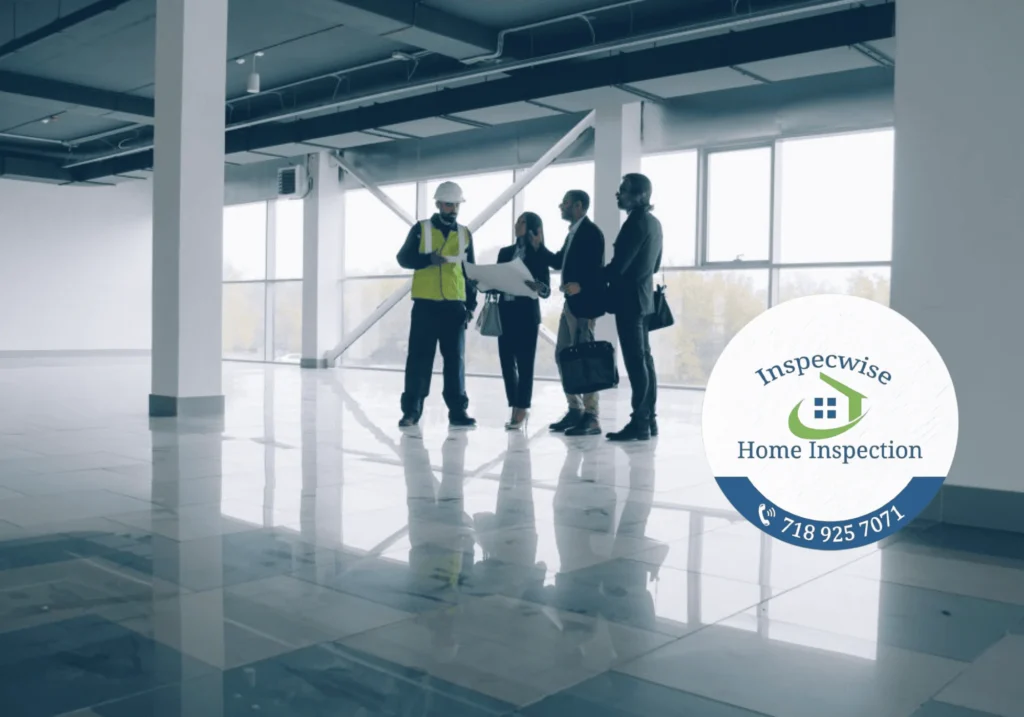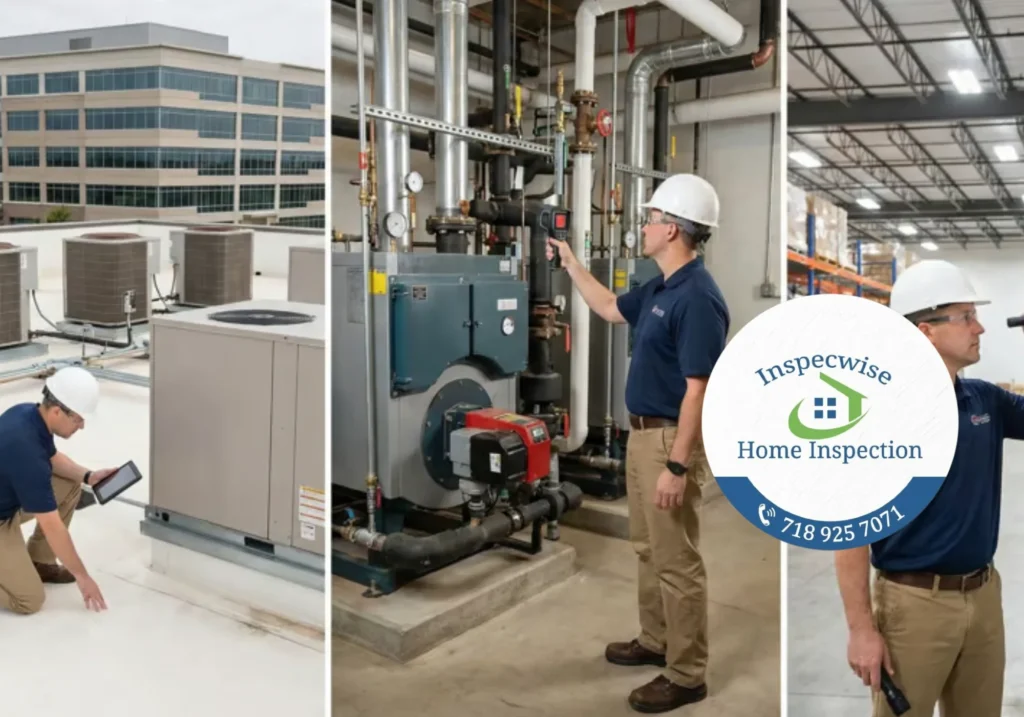
Commercial Property Inspection Queens has become a standard part of due diligence for anyone acquiring, leasing, or investing in the borough’s commercial real estate, from the glass office towers of Long Island City, to the industrial warehouses of Maspeth, the retail corridors of Flushing, and the mixed-use buildings of Jackson Heights and Astoria. Whether you are acquiring a property, signing a commercial lease, or evaluating a long-term investment, a commercial property inspection gives you an independent, evidence-based picture of what you are actually taking on, before the terms are final.
You are not only buying or leasing brick and mortar. You are also taking on the building’s mechanical history, its deferred maintenance, and any unresolved conditions in its structure or systems. Understanding those conditions early, rather than discovering them after closing, is the core purpose of commercial due diligence in Queens.

Commercial Property Inspection in Queens: Why Due Diligence Matters
A commercial acquisition, a triple-net lease, or a capital investment in Queens carries financial exposure that goes well beyond the purchase price or the base rent. In a market where commercial buildings can be decades old and have passed through multiple owners and tenant build-outs, the visible surface of a property rarely tells the full story.
Queens illustrates this well. In neighborhoods like Woodside, solid pre-war construction often houses electrical and plumbing infrastructure that was never designed for the power and capacity demands of a modern commercial tenant. In Long Island City, older industrial buildings converted to office or residential use may carry alterations that were never fully closed out with the Department of Buildings. In Maspeth and other industrial pockets, heavy equipment loads and loading-dock activity accelerate wear on flooring, structural elements, and electrical service in ways a casual walkthrough will not reveal.
An inspection performed before you sign gives you a documented, photo-supported account of the property’s condition: information you can use to plan capital expenditures, structure your offer, or decide whether to proceed at all. Waiting until after closing to discover a failing roof membrane or an undersized electrical service turns a negotiable issue into an unplanned repair bill.
For the full technical breakdown of our inspection methodology and building systems review, see our commercial building inspection nyc resource; the sections below focus on how those findings support a purchase, lease, or investment decision.
What Does a Commercial Property Inspection Cover?
A commercial property inspection is a systematic, non-invasive visual evaluation of a building’s major systems and components. For each system, the goal is the same: identify what is inspected, flag conditions that carry financial or operational risk, and be clear about what can and cannot be determined without invasive testing or specialized engineering review.
Structural Systems and Foundation
The inspection evaluates visible structural elements, including foundation walls, load-bearing columns, beams, and framing, for signs of settlement, cracking, water intrusion, or prior repair work. In areas near elevated transit lines or heavy truck routes, such as sections of Woodside and Maspeth, sustained vibration over decades can accelerate wear on masonry and foundation joints, so these conditions receive particular attention. A visual inspection can identify indicators of movement or distress; it cannot determine the underlying engineering cause. Where findings suggest a structural concern, further evaluation by a licensed structural engineer is recommended.
Roofing and Building Envelope
Roofing is frequently the single largest unplanned expense for a new commercial owner. The inspection evaluates the roofing system, whether EPDM, built-up roofing (BUR), or TPO, along with drainage, flashing, parapet conditions, and visible signs of ponding or membrane deterioration. Because commercial roofs are often large, low-slope, and difficult to fully assess from ground level or a single vantage point, a drone roof inspection can supplement the visual assessment with a more complete view of the membrane and drainage system, particularly on larger warehouse or office roofs.
Commercial HVAC and Mechanical Systems
Commercial HVAC, typically rooftop units (RTUs), split systems, or in some cases central plant equipment, is evaluated for age, visible condition, and operational response at the time of inspection. A 20-ton RTU nearing the end of its typical service life represents a significant, predictable capital expense, and knowing that before closing changes the negotiation. Our commercial HVAC inspection service documents unit age where determinable, visible maintenance condition, and operational performance during the walkthrough, while noting that a full mechanical load analysis or refrigerant-system evaluation falls outside the scope of a standard property inspection.
Electrical Systems
The inspection reviews the main electrical service, panel condition, visible wiring methods, and distribution to confirm whether the system appears adequate for the building’s current and intended commercial use. This matters most where a tenant’s equipment, such as commercial kitchen appliances, manufacturing machinery, or server rooms, requires three-phase power or higher-capacity service than an older building was originally designed to supply. Visible deficiencies such as double-tapped breakers, outdated panel types, or exposed wiring are documented; a full electrical load calculation is beyond the scope of a visual inspection and, when warranted, should be performed by a licensed electrician.
Plumbing and Drainage
Plumbing evaluation covers visible supply lines, drainage, fixtures, backflow prevention where applicable, and signs of leaks or prior water damage. For restaurants and other food-service tenants, gas-fired kitchen equipment and venting are reviewed for visible condition and general compliance posture. Because gas piping and appliance installation in New York City are governed by the NYC Fuel Gas Code, any conditions suggesting non-compliant gas work are flagged for licensed plumber or DOB follow-up.
Water heaters, sump pumps, and grease interceptors are reviewed where present, since each carries its own maintenance schedule and failure cost. In multi-tenant buildings, the inspection also notes whether individual units are metered separately or share a single supply line, which affects how repair and utility costs are typically allocated among tenants. None of this replaces a plumber’s internal camera work on lines that run below a slab or behind finished walls, which is why underground and below-grade drainage receives separate attention.
Underground and below-grade drainage lines are not visible during a standard inspection. When a property’s age or history suggests risk, particularly for older buildings or those with a history of backups, a commercial sewer scope inspection can provide a camera-based view of the lateral line that a walkthrough cannot.
Interior and Exterior Conditions
Interior finishes, ceilings, flooring, and tenant build-out conditions are reviewed for visible damage, moisture intrusion, and deferred maintenance. Exterior conditions, including facades, parking areas, signage structures, loading areas, and site drainage, are reviewed for conditions that could affect use, liability, or near-term maintenance cost. For buildings with occupied basement or below-grade space, particularly older Queens buildings where grading and drainage have shifted over decades, a basement inspection can identify moisture, seepage, or structural conditions specific to that level.
Safety, Accessibility, and Visible Deficiencies
The inspection reviews visible life-safety features, including egress paths, exit signage, fire separation where observable, and general accessibility conditions such as hallway width, ramp presence, and entrance clearances. This matters most in high-traffic retail environments, such as those found in Flushing’s commercial corridors, where inadequate egress or accessibility can create both a safety liability and a code-compliance exposure for a new owner or tenant.
Why Choose InspecWise for Commercial Property Inspection in Queens?
Choosing an inspector for a commercial transaction is different from choosing one for a single-family home purchase: the stakes, the systems, and the reporting needs are all more complex. Here is what InspecWise brings to a Queens commercial engagement, and why each element matters to a buyer, owner, investor, landlord, or tenant.
Licensed NY Inspector. Working with a New York-licensed inspector means the person walking your property is qualified under the state’s inspection standards and familiar with the construction types and code context specific to New York buildings, not a generalist applying out-of-state assumptions to a Queens property.
Commercial Specialists. Evaluating a commercial property is not the same exercise as a residential walkthrough. Commercial buildings involve rooftop mechanical equipment, higher-capacity electrical service, ADA and life-safety considerations, and property types such as warehouses, retail strips, and mixed-use buildings that a residentially focused inspector may not routinely encounter. Our commercial engagements are scoped around these differences.
InterNACHI Certified. InterNACHI certification reflects ongoing training and adherence to a defined standard of practice within the inspection industry. It complements, rather than replaces, state licensing and does not substitute for an engineering or specialty-trade evaluation where one is warranted.
Same-Day Scheduling. Commercial due-diligence periods are often short and contractually defined. Being able to schedule an inspection quickly after you go under contract, or before a lease deadline, helps you stay within your due-diligence window rather than requesting an extension.
Fast Report Turnaround. In a competitive Queens market, the speed of your findings can matter as much as their content, whether you are working toward a financing deadline, a lease-signing date, or a negotiation window with a seller. A prompt digital report keeps your transaction moving.
Detailed Digital Reports. Reports are organized around prioritized findings, high-resolution photo documentation, and clear system-by-system observations, so you and your legal, financing, or brokerage team can quickly understand the property’s actual condition instead of working through vague handwritten notes.
Serving NYC and Long Island. Beyond Queens, InspecWise supports commercial transactions in commercial inspection Manhattan, which is useful if your portfolio or your search extends into Manhattan and you want a consistent inspection standard across properties.
Competitive Pricing. Commercial inspection pricing is scoped to the property rather than a flat rate, so you are paying for the complexity of what is actually being inspected, not a one-size-fits-all fee that overcharges simple properties and undercharges complex ones.

Commercial Properties We Inspect in Queens
Commercial inspection priorities shift depending on property type. The table below summarizes the focus, and each property type is discussed in more detail after it.
| Property Type | Primary Inspection Focus |
|---|---|
| Office Buildings | HVAC distribution, electrical capacity, conversion and build-out closeout |
| Retail Spaces | Facade condition, HVAC, electrical capacity for signage, accessibility |
| Industrial Warehouses | Loading docks, flooring, large-scale electrical service, roof spans |
| Multifamily and Apartment | Common-area systems, roof and envelope, shared mechanical equipment |
| Mixed-Use Properties | Combined commercial and residential systems under one inspection |
| Restaurants and Food Service | Gas equipment, grease traps, ventilation, fire suppression |
Office Buildings
For office properties, including converted industrial-to-office spaces in Long Island City, the inspection emphasizes HVAC distribution across tenant floors, electrical capacity for modern workstation and server loads, and whether prior tenant build-outs and conversions were completed and closed out properly.
Retail Spaces
Retail inspections in corridors like Flushing focus on storefront and facade condition, HVAC serving open sales floors, electrical capacity for signage and equipment, and accessibility conditions that affect both customer safety and code compliance.

Industrial Warehouses
Warehouse and industrial properties in Maspeth and near JFK emphasize loading dock condition, heavy-duty flooring, large-scale electrical service for equipment and machinery, roof condition over large open spans, and drainage across expansive paved areas.
Multifamily and Apartment Buildings
For multifamily commercial assets, the inspection addresses building-wide systems, including common-area electrical and plumbing, roof and envelope condition, and shared mechanical equipment, alongside a sampling of individual unit conditions where access allows.
Mixed-Use Properties
Mixed-use buildings, common throughout Jackson Heights and Astoria, require a blended approach that evaluates both the commercial ground-floor space and the residential floors above under one inspection. If your holdings include a purely residential purchase alongside a commercial one, our home inspection Queens service applies the same rigor to that side of the transaction.
Restaurants and Other Commercial Properties
Restaurant and food-service properties carry additional scrutiny around gas-fired kitchen equipment, grease traps and drainage, ventilation, and fire-suppression systems, areas where deferred maintenance or non-permitted work can be especially costly to correct after closing.

How the Commercial Property Inspection Process Works
If you have never arranged a commercial inspection before, the process generally follows these steps:
- Initial scope discussion. We confirm property type, square footage, and any specific concerns, such as a failing roof, older mechanical equipment, or a pending lease deadline, so the inspection is scoped correctly.
- Document review, where applicable. If available, prior inspection reports, permit history, or maintenance records are reviewed to inform the on-site evaluation.
- On-site inspection. A physical walkthrough of accessible areas, from roof to below-grade space where applicable, following the systems outlined above.
- Building systems evaluation. Structural, envelope, HVAC, electrical, and plumbing conditions are assessed and documented in the field.
- Photo documentation. High-resolution photos capture both normal conditions and any identified deficiencies for reference in the final report.
- Findings prioritization. Observations are organized by urgency, separating conditions that need immediate attention from longer-term deferred maintenance.
- Digital report delivery. A structured report is delivered electronically, organized for quick review by you, your attorney, or your lender.
- Client discussion and next steps. We are available to walk through the findings and help you determine whether any conditions warrant a specialist follow-up before you move forward.
How Much Does a Commercial Property Inspection Cost in Queens?
Commercial inspection pricing is not one-size-fits-all, and any inspector quoting a flat universal rate is likely not accounting for the variation between property types. At InspecWise, pricing reflects the actual complexity of the property being inspected.
| Cost Factor | Why It Affects Pricing |
|---|---|
| Square footage | Larger buildings take longer to inspect thoroughly |
| Property type | A warehouse walkthrough differs from a restaurant inspection involving kitchen equipment and grease systems |
| Age of the building | Older properties often carry more layered mechanical and electrical history to evaluate |
| Number of mechanical units | Multiple RTUs or split systems take more time to assess than a single unit |
| Roof configuration | A single flat roof is faster to evaluate than a complex, multi-level roof with several drainage zones |
| Accessibility | Locked mechanical rooms, tenant-occupied space, or limited roof access can affect scope and scheduling |
| Occupancy status | A vacant property allows faster, more complete access than an occupied one |
| Additional scope | Services such as a sewer scope inspection, drone roof inspection, or radon testing are scoped separately from the core inspection |
For a full breakdown of how these factors combine, see our dedicated commercial inspection cost guide, or request an estimate specific to your property.
Queens Commercial Property Risks by Neighborhood
Queens’ commercial building stock varies significantly by submarket, and the inspection priorities shift accordingly.
Long Island City has seen substantial industrial-to-office and industrial-to-residential conversion activity. Inspections here often focus on whether mechanical systems were properly upgraded for the new use and whether conversion work was completed and closed out with the Department of Buildings.
Flushing’s dense retail corridors put a premium on accessibility, egress, and electrical capacity for high-turnover storefronts, particularly in older buildings retrofitted for modern retail tenants.
Astoria and Jackson Heights are characterized by mixed-use buildings combining ground-floor commercial space with residential units above, which calls for an inspection scope that addresses both uses under one roof.
Maspeth and Woodside house a significant share of Queens’ industrial and light-manufacturing stock, where heavy equipment loads, loading-dock wear, and older electrical infrastructure are common focus areas.
Jamaica and properties near JFK Airport are frequently logistics and warehouse oriented, with inspection priorities centered on loading docks, large-scale electrical service, and expansive roof and paved-area drainage.
Forest Hills and Bayside include a mix of established retail strips and smaller commercial buildings where facade condition and long-term mechanical maintenance history are common considerations.
Sunnyside, Ridgewood, Corona, and the Rockaways each carry their own building-age and property-type patterns; regardless of submarket, the inspection approach is driven by the building’s actual construction and use rather than by neighborhood alone.
If your portfolio extends beyond Queens, InspecWise also supports commercial due diligence in commercial inspection Brooklyn, giving multi-borough buyers and investors a consistent inspection standard across properties.
Commercial Property Inspection vs. Property Condition Assessment
Buyers, lenders, and investors sometimes ask whether a commercial property inspection is the same thing as a Property Condition Assessment (PCA). They are related but distinct services.
| Commercial Property Inspection | Property Condition Assessment (PCA) | |
|---|---|---|
| Typical purpose | Informs a buyer, tenant, or owner about current condition | Supports lender or institutional financing and acquisition decisions |
| Scope | Visual, non-invasive review of major systems | More formal, structured deliverable, often following industry frameworks such as ASTM E2018 |
| Typical requester | Buyer, tenant, landlord, or owner | Lender, institutional investor, or underwriter |
| Report focus | Immediate repairs, deferred maintenance, general condition | Immediate repairs, deferred maintenance, and estimated capital needs organized to a defined reporting standard |
| When it fits | Most acquisition, lease, and ownership due diligence | Financing-driven transactions with a specific PCA requirement |
When a PCA-style scope is requested, InspecWise structures findings around the categories buyers and lenders typically expect: immediate repairs, deferred maintenance, and estimated capital needs. A full ASTM E2018-compliant PCA involves a defined process that is a distinct, and often more extensive, engagement than a standard property inspection. If your transaction specifically requires a PCA for lender or investor purposes, confirm the exact scope needed before booking so the inspection can be structured accordingly.
NYC Due Diligence, DOB Records, and Property Conditions
A physical inspection is one part of commercial due diligence; reviewing the property’s regulatory history is the other. Before or alongside your inspection, it is worth reviewing the building’s Department of Buildings record for open permits, unresolved violations, and its current Certificate of Occupancy, since these documents can reveal unpermitted alterations or use restrictions that a walkthrough alone would not surface.
The DOB maintains public tools, including the Building Information System (BIS) and DOB NOW, that allow anyone to review a building’s history of violations, permits, and complaints, along with its current status as active or resolved. This makes record review a practical and accessible step in any Queens commercial transaction.
For older Queens buildings, it is also worth confirming that the current use matches what the Certificate of Occupancy actually permits. A commercial tenant operating in space classified for a different use, or a building that was informally converted from industrial to office or residential without a corresponding filing, can create complications for financing, insurance, or a future sale that are far easier to resolve before you are contractually committed than after.
Where a property’s use or history suggests it, additional due diligence such as radon testing can round out the picture before you commit.
For mixed-use buildings specifically, the residential floors above a commercial ground level fall under a different regulatory framework than the commercial space itself, which affects everything from egress requirements to permitted alterations. A review of applicable requirements under the NYC Residential Code for the residential portion of a mixed-use building is a useful companion step to your commercial inspection.
Understanding Your Commercial Inspection Report
Your report is organized to be useful under time pressure, not just comprehensive.
| Report Section | What It Contains |
|---|---|
| Executive Summary | High-level overview of the most significant findings |
| Immediate Repairs vs. Deferred Maintenance | Clear separation between near-term and longer-term items |
| Capital Expenditure Considerations | Systems likely to require future capital investment |
| Photo Documentation | High-resolution images supporting each significant finding |
| System Condition Summaries | Organized observations for each major building system |
| Limitations | What was and was not accessible or evaluable, and where specialist follow-up is recommended |
The report provides observed conditions and, where reasonable, general cost context. It is not a substitute for a formal contractor estimate, and any budget figures should be confirmed with a licensed contractor before you finalize repair or capital planning.
Using Inspection Findings During Commercial Property Negotiations
Inspection findings give buyers, tenants, and owners concrete, documented leverage in a transaction. Depending on what is found, findings can help you:
- Identify material defects that affect the property’s value or your intended use.
- Prioritize which repairs matter most before closing versus which can be addressed over time.
- Request a repair credit or price adjustment based on documented conditions.
- Budget realistically for near-term capital improvements after closing.
- Determine whether a specific finding, such as a structural crack, a suspected gas-code issue, or an aging roof, warrants a follow-up evaluation by a structural engineer, electrician, or other licensed specialist before you finalize the deal.
An inspection cannot guarantee savings or a successful negotiation. What it provides is documented, defensible information that puts you in a stronger position at the negotiating table, whatever the outcome.
Frequently Asked Questions About Commercial Property Inspection Queens
How much does a commercial property inspection cost in Queens? Cost depends on square footage, property type, age, number of mechanical units, and inspection scope. See the cost guide linked above for a full breakdown of these factors, or request a property-specific estimate.
How long does a commercial property inspection take? Duration varies with building size and complexity. A small retail space can be inspected in a few hours, while a large warehouse or multi-tenant office building may take a full day or longer.
Should I get an inspection before buying a commercial property? Yes. A pre-purchase inspection documents the building’s actual condition before you are contractually committed, giving you information to negotiate terms or reconsider the deal if significant issues are found.
Should I inspect a property before signing a commercial lease? It is advisable, particularly for triple-net leases where the tenant assumes responsibility for maintenance and repairs. Knowing the condition of the roof, HVAC, and electrical systems before you sign helps you understand what obligations you are taking on.
What is the difference between a commercial inspection and a PCA? A commercial property inspection is a visual condition assessment for a buyer, tenant, or owner. A Property Condition Assessment is typically a more formal deliverable, often requested by lenders, that commonly follows industry frameworks such as ASTM E2018. See the comparison table above for a full explanation.
Does a commercial inspection include HVAC and roofing? Yes. Both are core components of a standard commercial property inspection, given how costly they are to replace or repair.
Can inspection findings help with commercial property negotiations? Yes. Documented findings are commonly used to request repair credits, adjust price, or plan post-closing capital expenditures, though outcomes depend on the specific transaction and the parties involved.
What documents should I review before a Queens commercial property inspection? Where available, prior inspection reports, DOB permit and violation history, and the property’s Certificate of Occupancy provide useful context that can be reviewed alongside your physical inspection.
Schedule a Commercial Property Inspection in Queens
Whether you are a buyer preparing for a closing, an investor evaluating an acquisition, a landlord assessing your portfolio, or a tenant reviewing a property before signing a lease, InspecWise provides commercial property inspections throughout Queens, from Long Island City to the Rockaways, Flushing to Jamaica.
If your holdings extend into the Bronx, InspecWise also supports commercial inspection Bronx requests, using the same inspection standard applied across our Queens engagements.
For clients evaluating residential assets alongside their commercial holdings, our home inspection NYC service applies that same due-diligence approach citywide.
Call 718-925-7071 to discuss your property and schedule an inspection, or request an estimate to see how pricing applies to your specific building.
GET IN TOUCH
Schedule a Visit
Serving all Queens Neighborhoods: Astoria • Long Island City • Flushing • Forest Hills • Jamaica • Bayside • Jackson Heights • The Rockaways
Call Inspecwise now: 718-925-7071
Licensed, Certified, and 100% NYC Local